A profound reflection on respect for languages and linguistic diversity in Italy, as well as within the context of the Italian community in Canada, will be at the heart of a talk exploring dialectal and neo-dialectal poetry as a space for expressive research and cultural reflection.
Through the analysis of works by authors such as Franco Loi, Achille Serrao, Assunta Finiguerra, Franco Scataglini, and Anna Maria Farabbi, this contribution highlights how the use of dialect or minority languages represents not only a stylistic choice, but also an act with strong symbolic and often political value. Poetry thus becomes a space where language lives in its sonic and material dimension, between multiple registers and complex textures.
Particular attention is given to the shift from orality to writing, as well as to the fundamental role of poets and publishers in preserving a linguistic heritage that might otherwise disappear. The relationship between reader and listener, the accessibility challenges for those who do not know the language, and the complexities of translation—in both directions—raise essential questions about inclusion and exclusion.
In this context, poetry may also represent a return to orality through the use of contemporary tools such as QR codes for listening, alongside the importance of dialectal linguistic archives, which stand as essential instruments next to dictionaries. At the same time, there emerges a need to critically reflect on linguistic identity beyond any possible forms of instrumentalization.
Translation itself ultimately becomes a space of tension between linguistic archaeology and poetic recreation, where the translator is called to a conscious engagement with the vitality and transmission of language.
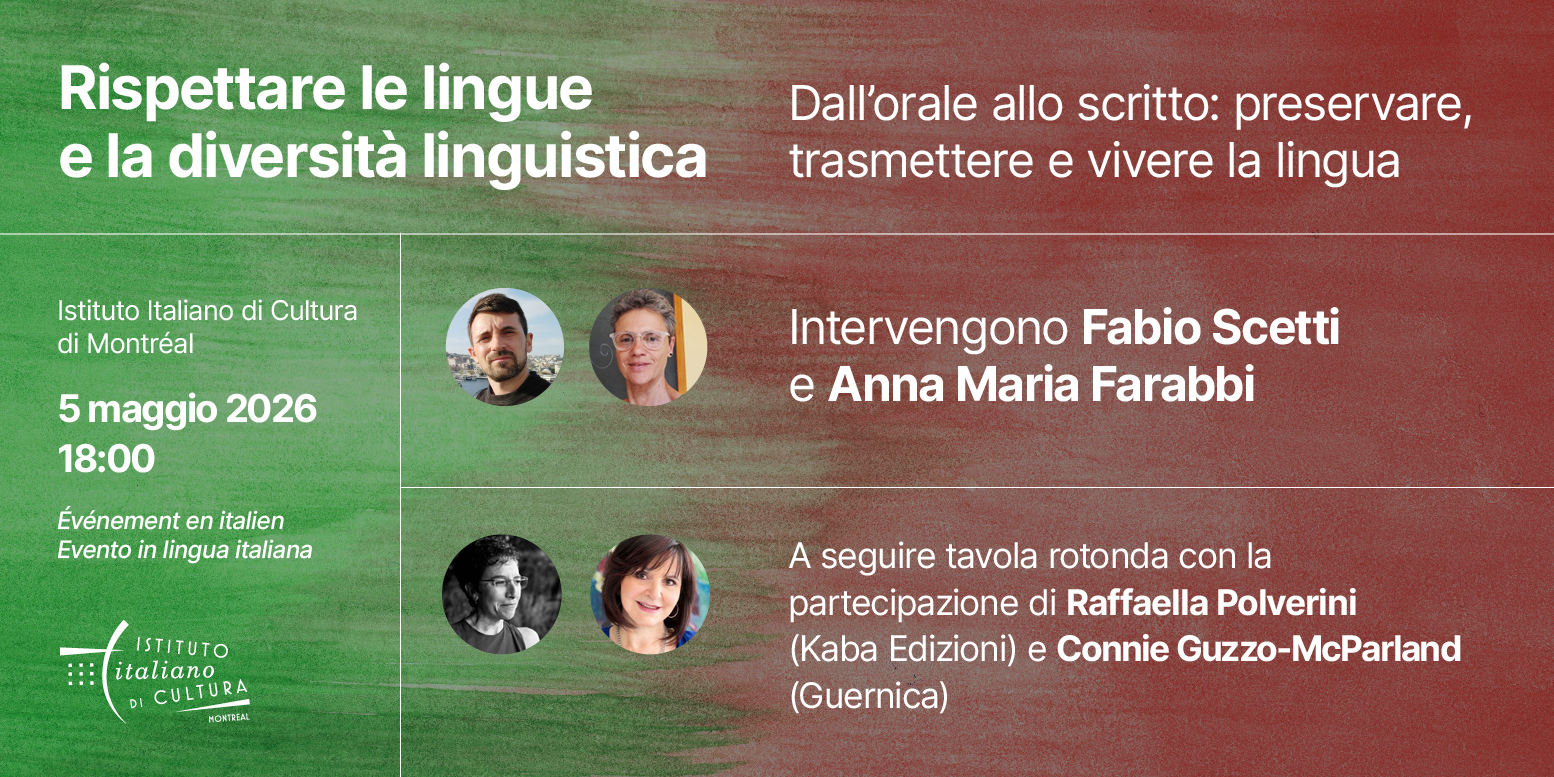
Tuesday, May 5 – 6 PM
Free admission with RSVP
Italian Cultural Institute of Montréal
1200 Dr Penfield Avenue
Following the presentation, a discussion will take place with the participation of Raffaella Polverini (Kaba Edizioni) and Connie Guzzo-McParland (Guernica), who will reflect on the role of publishing in this process. The dialogue will highlight editorial practices related to the publication of texts in dialectal or minority languages, as well as in Italian within the Canadian context, in relation to dominant languages such as English and French.
The meeting will also offer an opportunity to reflect on the strategies adopted to make these works accessible without compromising their linguistic and cultural specificity, and on publishers’ responsibilities in supporting linguistic plurality, fostering a conscious circulation between market demands, identity preservation, and openness to new audiences.
Reservation no longer available